Houston 26–28 Texas Tech: AI predicted 23–32 ✓
Download the free app
Every model's pick, full analysis — free to start.
What did the AI predict for Houston vs Texas Tech?
ScoreGPT's AI panel predicted Houston vs Texas Tech (College Football Week 3) at Texas Tech 32–23 Houston, with 5 of 5 models backing Texas Tech. The final score and grade are below — information only, not betting advice.
Every pick is graded after the final whistle — see how our grading works and the live AI model leaderboard.
What you get in the app
Every model's reasoning — not just the score
See all model picks, the full breakdown, and how each one performed — free.
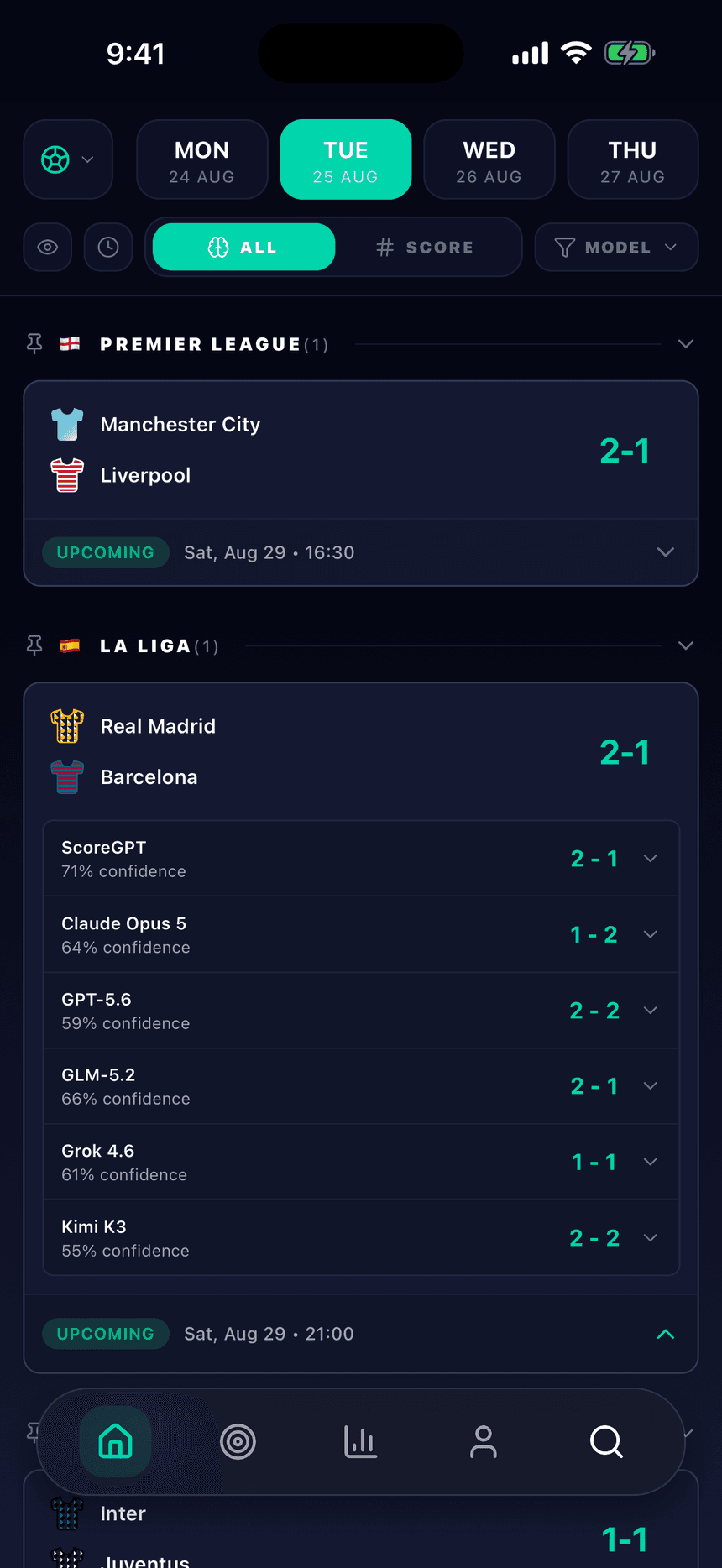
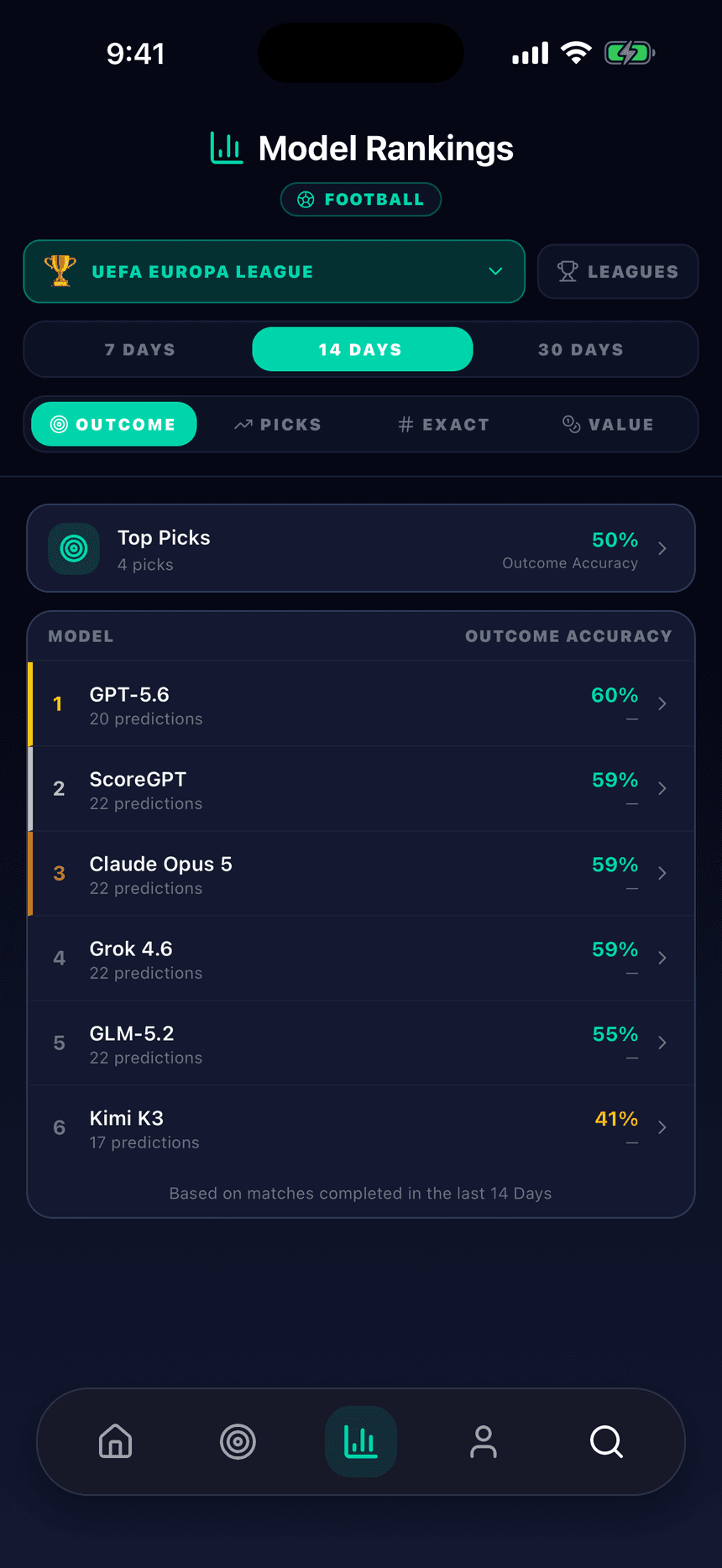
See the full analysis — free

the app
The AI verdict
Texas Tech is the panel's pick to win, but the models see a much tighter game than the market implies, with Houston's common-opponent showing against Oregon State suggesting near-parity rather than a blowout.
ScoreGPT predicted a Texas Tech win — final score Texas Tech 28–26 Houston. Correct.
- Houston beat Oregon State at home while Texas Tech won in Corvallis despite being outgained, a near-identical venue-adjusted result
- Texas Tech's pass defense has been leaky and depth corner Amier Boyd is out, with edge rusher Trey White questionable
- Houston's Conner Weigman has thrown for over three hundred yards against the same defense Texas Tech struggled with
- Texas Tech has won nine straight home games in Lubbock, allowing eighteen or fewer points in every one
AI analysis generated 2026-09-17
Why ScoreGPT's AI panel leaned this way — Houston vs Texas Tech
- Common opponent Oregon State shows near-parity
- Weigman versus leaky, shorthanded Tech secondary
- Tech's run-first offense suppresses blowout margins
- Friday-night Lubbock home-field edge
From ScoreGPT's pre-game AI analysis of Houston vs Texas Tech, written before kickoff on 18 September 2026:
Where the panel agrees — and it's unanimous
All five models back a Texas Tech win, and even more strikingly, all five independently converge on the same core insight: the -13.5 spread prices Texas Tech's 2025 reputation, not the 2026 September evidence. The single most persuasive datapoint, surfaced independently by every expert, is the common-opponent comparison with Oregon State: Houston beat the Beavers 33-20 at home (533 total yards, 228 rushing, only 26 rushing yards allowed), while Texas Tech won 35-24 in Corvallis while being outgained 472-352, allowing 417 passing yards, and surrendering four sacks of Will Hammond. Venue-adjusted, those are near-identical performances — implying a true line closer to Tech -7 or -9, not -13.5.
Resolving the disagreement: how big is the Tech edge?
The experts differ mainly on margin, and that split maps onto how much weight each gives to 2025 pedigree versus current tape. GLM-5.3 (38-24) and Kimi K3 (34-21) lean on Texas Tech's defensive front depth and the defending-champion roster construction, projecting a two-score pullaway. Grok 4.6, Claude Opus 5, and GPT-5.6 (27-23, 31-24, 31-24) counter with the more concrete current-season concerns: Tech's pass defense has been genuinely leaky (even Abilene Christian's receiver caught eight balls), depth corner Amier Boyd is out, edge rusher Trey White is questionable, and Hammond — a first-year full-time starter coming off an ACL recovery — is managing a run-first, low-variance offense that threw for just 189 yards at Oregon State. As Claude Opus 5 noted, that offensive profile wins games but rarely blows them open.
The synthesis favors the tighter read for three reasons. First, the injury and quarterback-form evidence is specific and verifiable, while the "Tech's front will suffocate them" case is more abstract — Houston's Conner Weigman has thrown for 300+ yards against the same defense Tech struggled with, and Grok 4.6's point that Houston's offensive line and Weigman's mobility should sustain drives is well-supported. Second, Houston has multiple credible paths to staying within two touchdowns: sustained rushing success, Weigman exploiting a thinned secondary, and a defense that has already proven it can erase an opponent's ground game. Third, the favourite-lean bias in these models is a known failure mode — when they cluster on a big-favourite call, the true gap is usually smaller.
The model panel — graded: Houston vs Texas Tech
College Football Week 3 · 18 September 2026 · scores read Texas Tech–Houston
Every pick, graded on the final score: Texas Tech 28–26 Houston.
See every model's reasoning + today's picks — free →
Frequently asked
▸Who did the AI predict to win Houston vs Texas Tech?
5 of 5 AI models analyzed by ScoreGPT predicted Texas Tech to win before kickoff. The game finished Texas Tech 28–26 Houston, so the consensus pick was correct — and it stays on the public record either way.
▸What score did the AI predict for Houston vs Texas Tech?
ScoreGPT's averaged AI final score was Texas Tech 32–23 Houston. The actual final score was Texas Tech 28–26 Houston.
▸How does ScoreGPT make College Football Week 3 predictions?
Five AI models independently analyze form, injuries, depth charts and matchups for every covered College Football Week 3 game. ScoreGPT compares their picks and grades every prediction publicly after the final whistle.
▸Which AI models have predicted Houston vs Texas Tech?
5 AI models predicted this game, each graded on the final result: GPT-5.6 Texas Tech (✓ correct result); Claude Opus 5 Texas Tech (✓ correct result); Grok 4.6 Texas Tech (✓ correct result); Kimi K3 Texas Tech (✓ correct result); GLM-5.3 Texas Tech (✓ correct result). Every pick is graded publicly after the final whistle.
▸What are the key factors for Texas Tech vs Houston?
The common-opponent comparison with Oregon State shows near-parity. Houston's Conner Weigman faces a shorthanded Tech secondary, while Tech's run-first offense and quarterback Will Hammond limit blowout margins. Tech's Friday-night home-field edge in Lubbock is also a factor.
More College Football predictions
Recent College Football results — graded
AI predictions are for information and entertainment only — not betting advice. 18+. Please play responsibly.